When I was learning to edit, my friend Keith sat me down at an old iMac, opened Final Cut Pro, and had me record myself counting from zero to ten. Then he showed me the blade tool and said, "cut this so it sounds like you're saying your phone number." That was the whole lesson. The footage never changed. The story did. More than a decade later, that is still the only thing I think editing is: taking what you were given and arranging it until it says something true.
I'm writing this because the way I do that arranging has changed more in the last year than in the ten years before it, and I think the editors I came up with deserve an honest account of it from someone who still shoots, still cuts, and still answers to real clients with real deadlines.
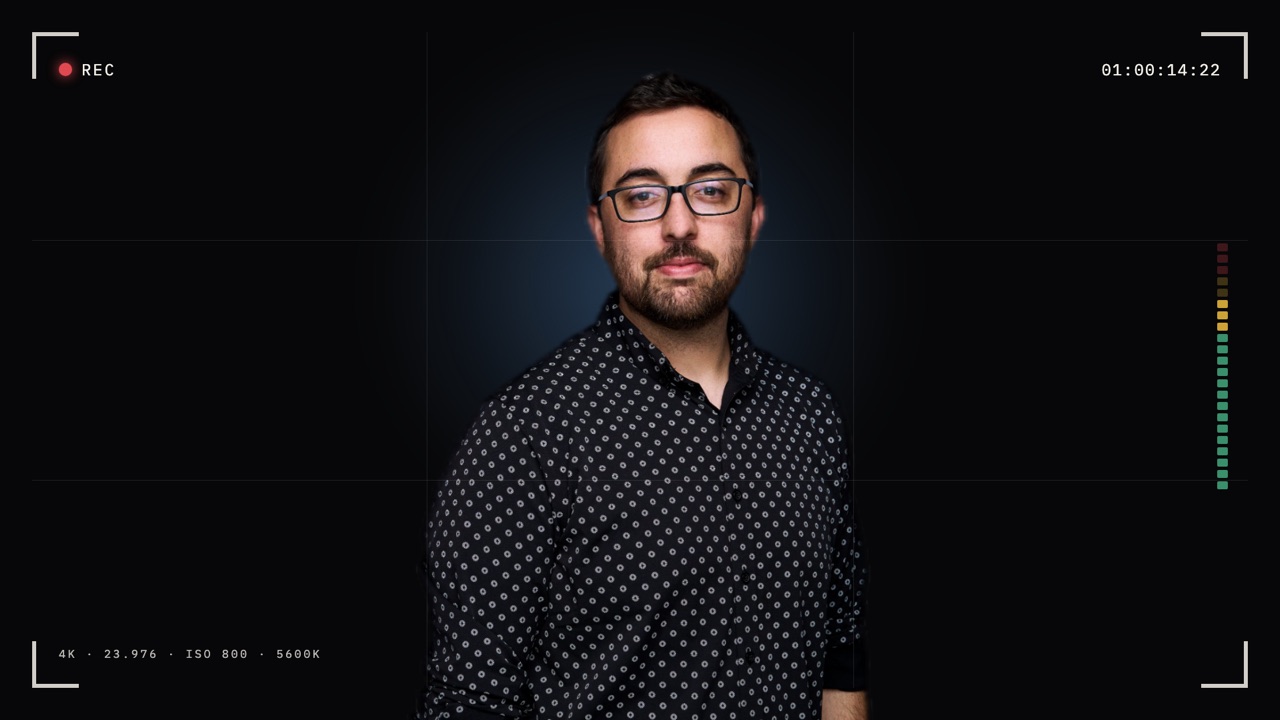
What my desk looks like now
Most days there are two monitors. Final Cut Pro is on one. Claude Code is on the other. And somewhere in between is Doza Assist, the app I built for finding the story inside interview footage. I'll be honest up front that I built it, so take anything I say about it with the grain of salt it deserves.
Here is the workflow, start to finish.
Every project gets a folder, and the folder gets read. For each client I keep a folder with everything they gave me: the brief, the goals, the fonts, the colors, the brand guide, the shot list, the schedule, the names of everyone we interviewed. This is the same folder I kept before any of this. The difference is that Claude Code can read it. So when I ask for a lower third in the client's typeface, in their blue, I don't have to explain who the client is or hunt for the hex code. It already knows. If you take one thing from this post, take that. The folder is the foundation. Everything else gets easier when the context is sitting right there.
Motion graphics come out of a conversation. I use Claude Code with Opus 5.5 to build the motion graphics for every project now, and the reason it works is that folder. Claude has already read the brand guide, the fonts, the colors, and whatever samples the client sent me, so every option it makes is already in the right typeface, the right blue, the right feel. I describe the move in plain English. It writes it. Then I ask for a ton of options. Ten lower thirds. Six ways to animate the chart. Three end cards. They come back in minutes, all on brand, and I pick the winners the way I'd pick selects from an interview. I look at one I like, say "slower, and the line should draw on instead of fade," and a new version is back before I've finished my coffee. Titles, lower thirds, animated charts, maps, callouts, the end card. A few years ago that was a weekend I lost or a subcontractor I paid, and I'd see two options, not twenty.
Interviews get transcribed before I watch them. This is where Doza Assist does its work. I drop in the interview files and it transcribes them on my Mac, nothing uploaded anywhere, labels the speakers, and then does the thing I used to spend the first two days of every edit doing: it reads the whole interview the way an editor would, pulls the moments that matter, finds the throughline, and writes me a brief. I built it because I had too many projects where a client handed me hours of footage and the first pass was always the same. Listen to everything. Mark the good parts. Find the spine. That first pass is what the software does. The choices stay mine. When a client wants to read along or pick their own moments, I share the transcript and the selects with them through Doza Studio and we're looking at the same page.
MCP, if you can. This part is newer and a little nerdy, so bear with me. MCP stands for Model Context Protocol. The simplest way I can put it: it's a standard plug that lets an AI assistant read from an app on your computer, with your permission, instead of you copying and pasting things into a chat window. Doza Assist has one built in. So in Claude Code I can say "read the Maria interview and give me three ways to open this film," and it's reading her actual transcript, with the real timecodes, not a summary I typed out. Or "what did anyone say about the first winter," and it searches every interview in the project. If your tools don't support it yet, copy and paste works fine. I did it that way for months. MCP isn't required. It just removes the friction between the AI and the footage, and once you've felt that you won't go back. I wrote more about why that connector exists if you want the longer version.
Then I go edit. Everything lands in the timeline. Doza Assist hands Final Cut a stringout of the selects, the graphics drop in from the project folder, and then I do what I have always done. This is where the flow lives. The pacing, the vibe, the choice of which line opens the film and which one you hold for the end, the breath before a cut, the music coming in a beat later than you'd expect. This is where I'm really directing. I cut. I move things. I sit with it. I take out the line I loved because it doesn't earn its place.
And when something is missing, I go back. This is where the chat in Doza Assist has quietly become my partner in story. Once I'm deep in the edit, hours in, the timeline mostly built, I'm not reading transcripts anymore. I'm asking questions. The middle sags, so I ask for a better soundbite for that turn in the narrative. I can't put my finger on what's wrong, so I ask what I'm missing. I ask what the client would want that I haven't given them. I ask whether there's a moment in any of these interviews I passed over that says this better. It has read every word of every interview in the project, so the answer comes back with the actual lines and the actual timecodes, and when I like one, it hands the clip straight into Final Cut. I don't go hunting. I don't scrub. Sometimes the answer is a line I forgot was there. Sometimes it's a nudge that confirms what I already felt. Either way I'm back in the cut in a few minutes, not an afternoon, and the conversation picks up where we left off the next time I'm stuck. It feels less like using software and more like having a story editor in the next room who has watched everything and never gets tired of the question "what if we opened with her instead?"
Final Cut, Premiere, Resolve, it doesn't matter. The NLE is where the taste lives, and nothing above changes what makes a cut good.
Editing has always changed
I learned on Final Cut 7. Then Apple blew it up and I learned Final Cut Pro X, which plenty of people swore they'd never touch. Today I know great editors on Resolve, great editors on Premiere, and honestly, people making things that move me in Canva and CapCut on their phones. Every few years the tool changes and every few years someone announces that the craft is over.
But here's the thing I've come to believe after more than a decade of this. The tool is like the camera, or the fancy degree, or the brand of your lenses. When it comes to telling a story, none of it really matters. What matters is how you make the audience feel. Nobody in the audience has ever asked me which NLE I used. Not the family on a museum couch with headphones on, not the client watching the first cut, not the stranger scrolling past it on their phone. They felt something or they didn't. That is the whole job, and it was the whole job before any of these tools existed, and it will be the whole job after whatever comes next.
So I don't see AI as the thing that ends editing. I see it as the next Final Cut X. Loud, disruptive, moving faster than I'd like, and in the end, just another tool that either helps you make the audience feel something or doesn't.
We are all directors now
Here is the shift I didn't expect. I see myself as a director now more than an editor. Not because I stopped cutting. Because the hours I used to spend scrubbing through footage looking for the good part are now spent on the only question that ever mattered: what is this film about, and does every cut serve it?
And I think that's true for all of us. If you know how to edit and you know how to tell a great story, you are already way ahead. That instinct for where a cut lands, for which line carries the weight, for what to leave out, that is the rare thing. The tools are not. If we want to stay in the game, we have to pick up the new ones and see whether they make our storytelling better. So far, I think they can. I'm taking on more work. I'm pickier about which work. And the work is better, because the part of the job I'm best at, the judgment, the structure, the sense of what a client actually needs even when they can't say it, is getting more of my time instead of less.
If you want to try it
A short list, in the order I'd do it.
- Make a folder for your next project with everything the client gave you. Brief, brand guide, fonts, colors, names. Keep it current.
- Point Claude Code at that folder and ask for one small thing. A lower third. See how it feels.
- Transcribe every interview before you watch it. Read first, then watch. Use Doza Assist or anything else that works for you. The habit matters more than the tool. If you want to see it done, the How-To series is eleven short films on one real interview.
- If your tools can talk to each other over MCP, connect them. If not, copy and paste. You'll still be faster than you were.
- Finish in your NLE, the way you always have. Trust your taste. That's the part no one is automating.
The blade tool got smarter
Keith's lesson still holds. The footage is the footage. The story is what you make of it. The blade tool got a lot smarter this year, and I expect it to get smarter again next year, but the question it answers hasn't moved an inch. What is this footage trying to say, and how do I get out of its way?
Story is and always will be the point. The tools around it are going to keep changing, faster than any of us would like. If I want to keep creating for a living, I have to change with them. That isn't a defeat. That's the job it always was. I'm just trying to stay one step ahead, and honestly, grateful I still get to do this at all.
Doza Assist is at doza.ai and on FxFactory. It runs on your Mac and your footage never leaves it. If you want to talk about any of this, the Discord is where I am most days, and my film work lives at dozavisuals.com.