How to find the story in interview footage.
Interview footage has no plot until you find one. Read the transcripts for beats, write the through-line in a sentence, put the shape on one page and name the gaps before you cut.
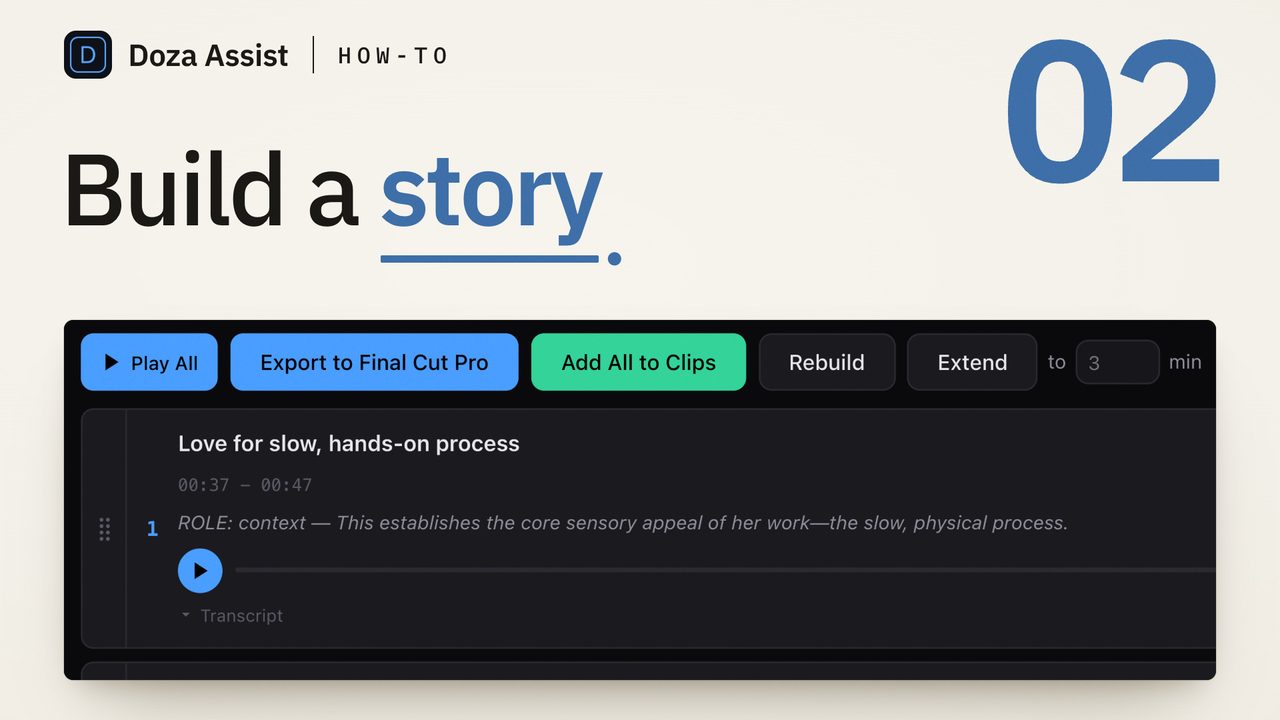
To find the story in interview footage, stop watching and start reading: transcribe every interview, mark the moments where something changes, sort those moments into the order they happened, and look for the through-line that connects them. Write that shape on one page, then list what the page needs that the footage does not have. The story is the brief plus the gaps.
Why does interview footage hide its story?
Because nobody told it in order. A subject answers the questions in the order they were asked, circles back, tells the best part twice and buries the turning point in a subordinate clause. Across six interviews the same event is told six ways, and the version that works for the film is a composite none of them said whole.
Watching dailies gives you the feel of the footage and almost no map of it: by hour three you remember a tone, and the line that mattered was the quiet one in hour two. The story is in the footage, in pieces, and finding it is a reading job before it is a cutting job.
What is a beat, and what is a through-line?
A beat is a moment where something changes: a decision, a reversal, a first time, a last time, a line after which the subject understands their own life differently. Not every good quote is a beat. "The lake was beautiful that morning" is texture. "That was the morning I decided to stay" is a beat. Hunting for beats is a different hunt from hunting for sound bites: a sound bite is a line that plays well, a beat is a line the story cannot do without, and the moments you build a film on are both.
A through-line is the question the beats answer in sequence. It is one sentence, usually with a want in it: a woman tries to keep the farm her father lost. It is not the topic (the farm crisis) and not the theme (what we owe the dead). If you cannot write the sentence, you have footage about a subject, not a story about a person. That is fine for a profile and fatal for a film.
How do you find the story in interview footage?
- Transcribe everything and read it, not the picture. Every interview, speakers labeled, timecodes on the words. Reading is faster than watching, and it strips the delivery away, which is what you want here: a line that sounds wonderful can say nothing, and the one that turns the story can be mumbled. Read each interview end to end once before you mark anything.
- Mark every moment where something changes. On the second read, mark beats: decisions, reversals, discoveries, the lines after which the subject is a different person. Mark the whole thought, setup and payoff, and ignore whether it is quotable. Use three colors, the same on every project: one for beats, one for texture, one for lines that explain something the audience will need to know.
- Write each beat on one line and sort the lines. Clip name, timecode, five words. Then put the lines in the order the events happened in the subject's life, not the order they came up in the interview. Read the list down: a story shows itself as a run of lines where each raises the stakes of the next. Where the list repeats, pick the best telling and note the others as backups.
- Write the through-line in one sentence. Someone wants something, something stands in the way, something happens. If it takes two sentences you have two stories; pick one, or name both threads. Then test the sentence against the list: every beat should move it forward or earn its place as texture. If most of the beats do not fit, the sentence is wrong, not the beats.
- Put the shape on one page. The through-line, the beats in order with a clip and a timecode each, who carries each section, the opening beat and the closing beat. This brief is not a paper edit: no runtime, no lines in full, only the shape. Everyone can argue with one page; nobody reads a forty-page selects document.
- List the gaps. Read the page as a stranger and write down every question it raises that the footage does not answer. Why did the brother never call again? Each gap is a pickup interview, a question for the next shoot, an archive search, a card or a line of narration. Name them now, while there is still a shoot day left.
- Build the paper edit from the brief, not from the selects. With the shape agreed, the paper edit is the brief expanded into lines: each beat becomes a clip with an In and an Out, texture fills the space between beats, and the runtime gets counted for the first time. Shape first, then selects, is the order that keeps a rough cut from turning into a selects reel with music on it.
When one read is not enough
One interview reads in an hour. Six read in a day. Twenty read in a week, and by the twentieth you have lost the first. This is where the method strains: the same night told by four people who contradict each other, and a through-line that sits in nobody's interview alone.
The reading is still the method. What changes is the bookkeeping. Keep one beat list for the whole project, not one per interview, tag every line with the speaker, and sort by story time. That puts the four tellings of the same night side by side, and it shows the empty stretch where nobody was asked what happened next, which is the first entry on the gap list.
Doza Assist is a local-first AI editing assistant for interviews and dialogue, and the finding pass is what it is built for. Every interview is transcribed on your Mac with each voice labeled, and AI Chat answers questions about the footage in plain words, with playable, timecoded clip cards and follow-up questions that remember what you are making: where does she decide to stay, who talks about the brother. On a collection of interviews, Story Brief surfaces the narrative beats across all of them and flags what is missing, which is a first draft of steps five and six to argue with. Soundbites are ranked across the whole interview, the 5-color highlighter in the Clip Library holds the beat, texture and explainer scheme, and the paper edit goes out to Final Cut Pro, Premiere Pro or DaVinci Resolve. Nothing uploads, and the free trial runs every feature on the first 2 minutes of each file; the documentary editors page shows the whole pass.
Common questions
Should I find the story before or after the shoot?
Before the shoot you have a hypothesis, which decides who to interview and what to ask. After each block of shooting, read what you have and rebuild the page, so the gap list drives the next block. The story you planned is the first thing to let go of once the footage says otherwise.
What is the difference between a beat and a sound bite?
A sound bite is a line that plays well on its own. A beat is a moment the story cannot skip. Many beats are flat in delivery and many sound bites change nothing. Mark beats first, sound bites second, and look hardest at the lines that are both.
How long should the brief be?
One page. The through-line in a sentence, the beats in order with a clip and a timecode each, who carries each section, and the gaps. If it needs a second page it is becoming a paper edit, which comes next and has a different job: lines in full, Ins and Outs, a runtime.
What if the footage has no story?
Usually it has one you did not plan for, so read the beat list again without the sentence you walked in with. If it really shows no run of change, you have a portrait or a topic, and the honest choices are to cut it as that, to supply the movement with narration or a journey of your own, or to shoot the pickup that gives the subject a want. The gap list tells you which.
Doza Assist transcribes every interview locally, finds the strongest moments across all of them, then sends your chosen ranges to Final Cut, Premiere, or Resolve. Your video never leaves your Mac.
Free trial: every feature on your first 2 minutes — no account, no card · 30-day money-back guarantee · Requires a Mac with Apple Silicon (M1 or later)